
When people hear the term “hacker,” it often carries a negative meaning, associated with cybercrime, data breaches, and unauthorized access. As discussed in “The Dark Side of Hacking: Who Are Black Hat Hackers?”, malicious actors play a significant role in today’s threat landscape. But not all hackers operate with harmful intent. In fact, some of the most important players in cybersecurity today are hackers themselves, working legally to protect systems rather than exploit them.
From Threat to Defense
The rise of cyber threats has changed how organizations think about security. It is no longer enough to build defenses and wait for attacks to happen. Businesses need to understand how attackers think, how they operate, and where systems are most vulnerable. This is where white hat hackers come in. Also known as ethical or legal hackers, they use the same skills and techniques as malicious actors, but with permission and a clear objective: to identify weaknesses before they can be exploited.
Thinking Like a Safety Attacker
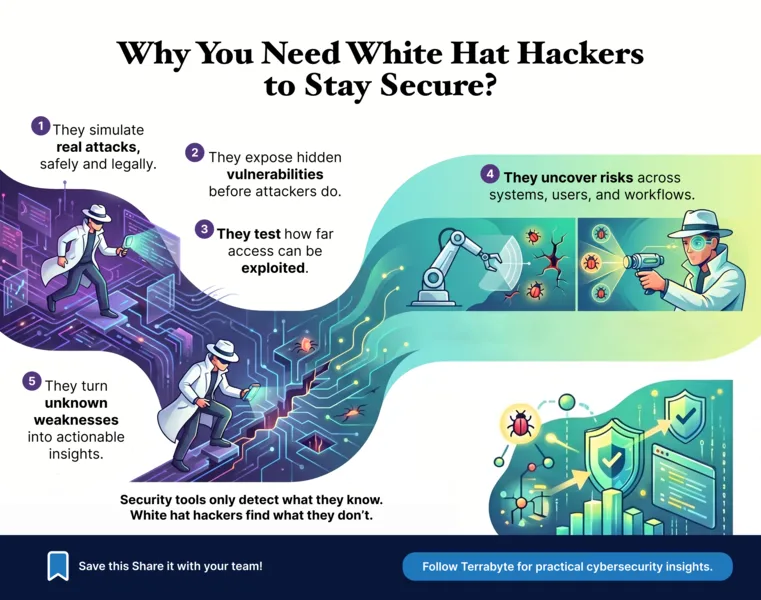
Traditional security tools are designed to detect known threats and enforce policies. However, they do not always uncover hidden vulnerabilities or unexpected attack paths. White hat hackers take a different approach. They simulate real-world attacks, testing systems in ways that mirror how black hat hackers would operate. This includes probing weaknesses, attempting to bypass controls, and exploring how far access can be extended. The difference lies in intent and authorization. Their goal is not to cause damage, but to reveal risks that might otherwise go unnoticed.
Why Organizations Need Legal Hackers
Modern environments are too complex to rely solely on automated tools. Cloud systems, remote access, APIs, and interconnected platforms create countless potential entry points. Even well-secured systems can have gaps. White hat hackers help organizations uncover these gaps by going beyond standard checks. They identify not only technical vulnerabilities, but also weaknesses in processes, configurations, and real-world usage. This makes security more realistic and more effective.
The role of white hat hackers is not limited to finding problems. Their insights help organizations strengthen their overall security posture. By understanding how an attack could happen, businesses can:
- improve defenses
- refine access controls
- reduce exposure across systems
This shifts security from reactive to proactive, allowing organizations to address risks before they become incidents.
The Growing Demand for Ethical Hacking
As cyber threats continue to evolve, the demand for ethical hackers is increasing. Organizations are recognizing that defending against attacks requires the same level of expertise as launching them. This has led to the growth of structured programs such as penetration testing, vulnerability assessments, and bug bounty initiatives. These efforts allow organizations to continuously test and improve their defenses in a controlled and legal manner.
A Necessary Balance in Cybersecurity
The existence of both black hat and white hat hackers highlights an important reality: cybersecurity is not just about technology, but about people and expertise. While malicious actors continue to develop new techniques, ethical hackers work to stay one step ahead, using similar skills to protect rather than exploit.
White hat hackers provide this capability. They bring real-world perspectives, challenge assumptions, and help organizations see their systems the way attackers would. Through Terrabyte, businesses can explore modern cybersecurity approaches that incorporate ethical hacking as part of a broader, proactive security strategy, ensuring that risks are identified before they become real threats.