
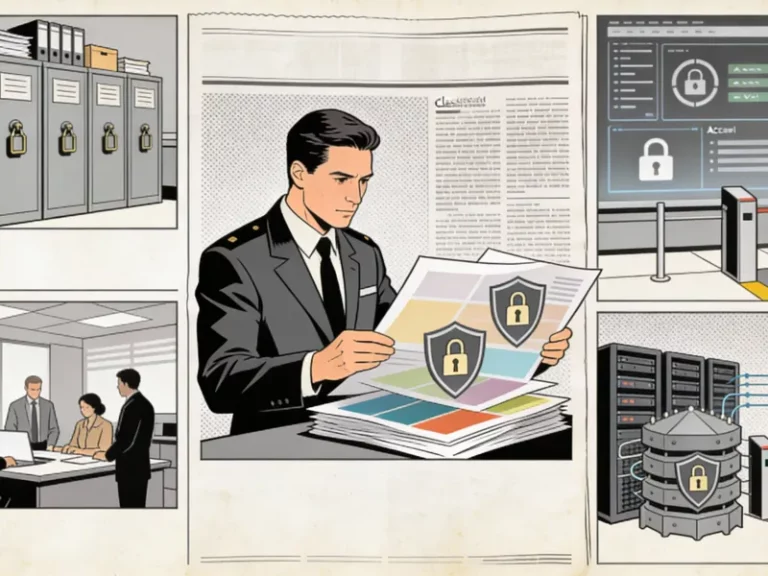
Many organizations already have security classification policies, yet sensitive data is still mishandled during daily work. Sensitive data continues to be mishandled, overshared, or exposed. The challenge often lies not in the guide itself, but in how it is applied in real operations.
In the previous article, “What Is a Security Classification Guide and Why Every Business Needs One,” we explained the role of classification guides in defining how information should be labeled and protected. What often comes next, and where many organizations struggle, is turning that guide from a static document into a living part of daily workflows.
Security Classification Beyond Definitions
A Security Classification Guide is not meant to sit in a policy folder waiting for audits. In practice, it should influence how data is created, shared, stored, and retired. Every email, report, spreadsheet, or system of export represents a decision point where classification matters.
When classification is treated as an abstract concept rather than an operational habit, employees rely on assumptions instead of guidance. This is where sensitive information quietly slips into unsecured channels or becomes accessible to unintended audiences.
How Classification Is Applied in Daily Work
In real operations, classification should begin at the moment when data is created. Business teams generate documents under time pressure, often prioritizing speed over security. If classification steps are unclear or disruptive, they are skipped entirely.
Effective classification guides work because they align with how people actually work. They provide clear, usable direction that integrates naturally into tools and workflows, rather than adding friction. When classification becomes intuitive instead of administrative, consistency improves significantly.
Where Classification Often Breaks Down
One of the most common failures occurs during collaboration. Files move between departments, partners, and platforms, but classification labels do not always move with them. Over time, data loses context, and protection weakens.
Another breakdown happens during system changes such as migrations, backups, or project handovers. Without active classification enforcement, sensitive data may be copied, duplicated, or stored without appropriate controls, increasing exposure without anyone noticing.
The Gap Between Policy and Behavior
Policies assume ideal behavior. Real operations reflect human habits. Employees may understand classification rules in theory but struggle to apply them under deadlines, remote work conditions, or complex tool environments.
This gap does not mean classification guides are ineffective. It means they must be designed with operational reality in mind. Clear ownership, consistent reinforcement, and alignment with business processes are what turn classification from policy into practice.
Making Classification Operationally Relevant
For a Security Classification Guide to work in real environments, it must be visible, practical, and reinforced through daily activity. Classification should support productivity, not compete with it. When teams understand why classification exists and how it protects both the business and their work, compliance becomes a natural outcome rather than an obligation.
Organizations that treat classification as a continuous operational process, not a one-time policy exercise, are better positioned to manage risk, respond to incidents, and maintain trust.
From Documentation to Daily Discipline
Security classification succeeds when it becomes an integral part of the organizational discipline. It is not just about labeling information but about shaping how data flows across systems and people. The most effective guides evolve alongside business operations, reflecting how work is actually done.
Terrabyte helps organizations transform security classification guides from static documents into practical frameworks that support real workflows, reduce exposure, and strengthen overall cybersecurity posture.